
Touch Controls and Flex Circuit Boards
If you’re considering a flexible touch control for your product, there are many design decisions to make. One major consideration is how your flex circuit will interact with rigid boards. Unlike ribbon cables, which require relatively tall and bulky connectors, flex circuits can be integrated with rigid boards to eliminate the need for external connections altogether. The conductor density of a flex circuit can also far exceed that of a ribbon cable, meaning that more complex, three-dimensional shapes can be accommodated.
The flex circuit boards used in these products must be able to withstand the dynamic environment and repeated bending they will experience in real-world use. To achieve this, you’ll need to select the correct flex circuit type and class for your application. You’ll also need to select the right materials for your flex PCB. The substrate material, coverlay and flexible solder mask must be suitable for the expected flexing. Depending on your needs, you may need to add stiffeners or other mechanical support.
To prevent traces from breaking during bending, it’s important to route them perpendicular to the bend line. The conductors must also be thin enough to avoid stress points when transitioning from a wider to a narrower area. A change in width that occurs suddenly is a stress point, which can cause the copper to break.
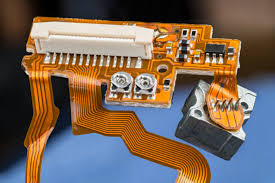
Flexible Touch Controls and Flex Circuit Boards
A flex circuit’s copper conductors must be protected by a dielectric layer. The most common option is a polyimide (PI) film. This insulates the copper, and it is also electrically conductive and can be made to be a solderable surface with electroless nickel immersion gold (ENIG).
You’ll need to consider how many layers your flex circuit will have and whether you want it to be double-sided. This will affect manufacturing cost. You’ll also need to decide if you’ll need plated through holes on the flex circuit and, if so, where they will be located.
Choosing the correct metal foil is another crucial step in designing a flex circuit. A thin, conductive foil will allow you to design your circuit for a low profile. However, if the flex circuit is intended to be very rugged and resilient you’ll need to choose a thicker, more rigid foil that can withstand the stresses of bending, folding, rolling and other dynamic motions.
Finally, you’ll need to decide if your flex circuit requires any special features like surface mount access openings or stiffeners. Stiffeners are areas of rigid material (usually FR4) added to specific parts of the flex PCB to provide additional strength and stability. This can help with mechanical stresses, but it will also increase the overall cost of the board. For this reason, it’s best to discuss your requirements with your flex circuit manufacturer before starting the design process.